
If you’ve been diagnosed with kidney stones requiring surgical intervention, you’ve likely come across two advanced laser procedures: RIRS and PCNL. Both are highly effective, but they cater to different scenarios. Understanding the difference is key to making an informed decision alongside your urologist.
Understanding the Procedures
Retrograde Intrarenal Surgery (RIRS): The Minimally Invasive Scout
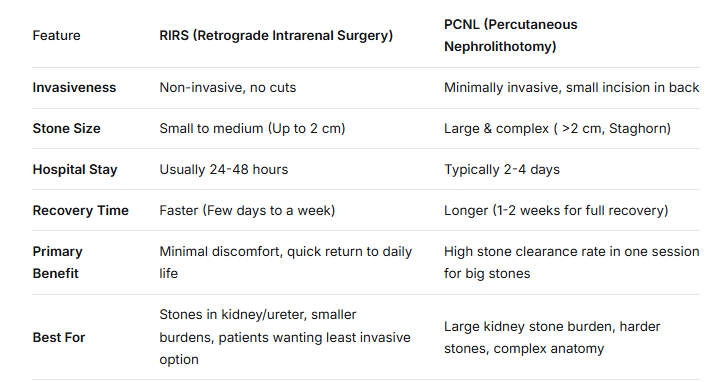
RIRS is a sophisticated, non-invasive procedure. A thin, flexible ureteroscope (a miniature camera) is passed naturally through the urethra and bladder, up into the ureter and kidney. No cuts or incisions are made. Once the stone is located, a laser fiber is passed through the scope to dust or fragment the stone into tiny pieces that can be passed naturally. It’s primarily used for stones up to 2 cm in size, located in the kidney or upper ureter.
Percutaneous Nephrolithotomy (PCNL): The Powerhouse Procedure
PCNL is designed for larger, more complex stones. A small (about 1 cm) incision is made in the patient’s back. Through this, a surgeon creates a direct tunnel into the kidney using a nephroscope. Powerful laser energy or ultrasonic devices are then used to break and remove the stones. It’s the gold-standard for large stones (over 2 cm), staghorn calculi (stones that branch into multiple parts of the kidney), or when other methods have failed.
RIRS vs. PCNL: A Quick Comparison
Which One is Right For You?
The choice isn’t yours to make alone, but depends on a detailed evaluation by your urologist. Key deciding factors include:
- Stone Size & Number: This is the most critical factor.
- Stone Location & Hardness: Position in the kidney and composition matter.
- Patient Anatomy: The structure of your urinary tract.
- Overall Health: Underlying conditions can influence safety.
- Previous Surgeries: History in the abdominal or kidney area.
Generally, RIRS is often preferred for its minimal recovery and no-scar benefit when stone size permits. PCNL is indisputably chosen for its efficiency in completely clearing large stone volumes in a single session.
Expert Care in Pune by Dr. Irfan Shaikh at Urolife Clinic
For those seeking expert guidance & Treatment Dr. Irfan Shaikh at Urolife Clinic is a renowned kidney stone specialist in Pune, Maharashtra. At Urolife Clinic, the focus is on providing clear communication and tailored treatment plans to effectively combat kidney stone disease.
FAQs on RIRS vs. PCNL
1. Which is better RIRS or PCNL?
RIRS is better for smaller stones (<2cm) due to its non-invasive nature. PCNL is better for larger, complex stones (>2cm) as it offers higher clearance in one go.
2. What is the success rate of RIRS vs PCNL?
Both have high success rates. PCNL has a slightly higher single-session clearance rate for large stones (over 90%). RIRS success for stones under 2cm is also very high, but sometimes requires a second procedure for complete clearance.
3. Is RIRS surgery painful?
RIRS is generally well-tolerated with minimal post-operative pain, mostly a feeling of urgency or mild burning during urination for a short period, managed with medications.
4. What is the main disadvantage of PCNL?
The main disadvantage is its invasiveness compared to RIRS, involving a small incision, longer hospital stay (2-4 days), and a recovery period of 1-2 weeks before heavy activity.
5. Which surgery is best for a 1.5 cm kidney stone?
For a 1.5 cm kidney stone, RIRS is often considered the first-line, best option as it is non-invasive with a faster recovery, provided the stone location and patient anatomy are suitable.